Skip to content
LEGENDSSPECIAL EDITIONS

LEGENDS — SPECIAL EDITION

RUBEN
RADA

1943–2026

Not a goodbye. A thank you.

More than a tribute, a celebration of his music and legacy.

A production by GEC PRODUCTIONS in collaboration with LEGENDS.

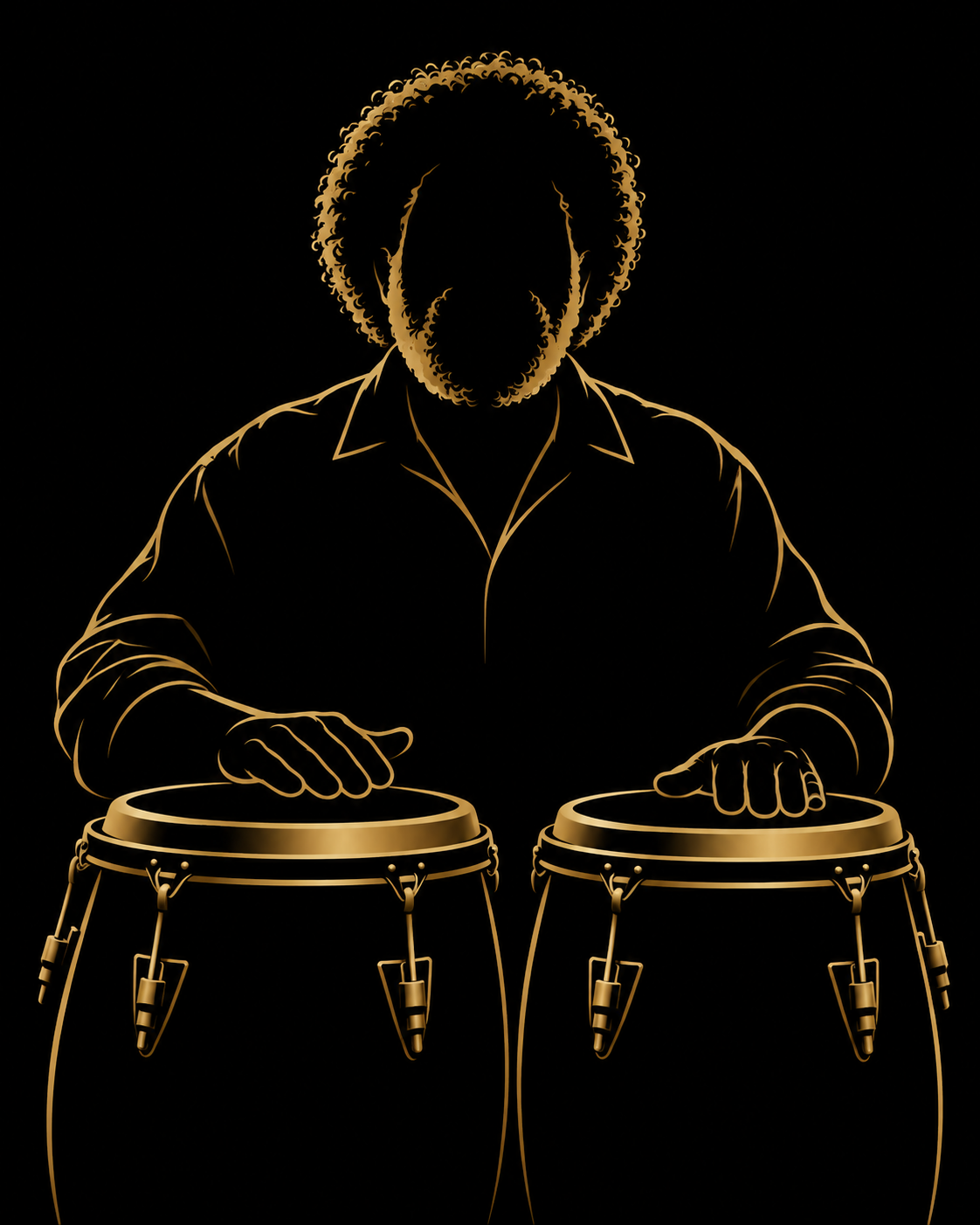
Vector-style illustration of Ruben Rada playing two conga drums in black and gold

01 / RUBEN RADA

A life in music

02

The neighbourhood as a school

Candombe was learned through listening and participation. Rada credited Pedro Ferreira with teaching him phrasing and remembered his father as a model on the drum. Carnival and Los Hot Blowers added humour, jazz and dance music. His singing could play with rhythm, imitate instruments and move from an intimate melody to an outburst of energy.

03

Mateo, El Kinto and a new musical language

Eduardo Mateo became a crucial creative partner. In El Kinto, songs in Spanish, beat music and Afro-Uruguayan rhythms came together in a pioneering sound. Candombe beat grew through several musicians and shared experiments. Recordings later appeared on releases such as Circa 1968, issued in 1977; that release date does not describe when the music was first created.

04

From Tótem to the world of OPA

Tótem pushed that exploration towards electric rock. Internationally, Rada’s compositions reached Airto Moreira and OPA, the group of Hugo and Osvaldo Fattoruso and Ringo Thielmann. His voice and percussion were central to Magic Time (1977). Through jazz fusion, candombe travelled while retaining its rhythmic personality.

05

Argentina, Mexico and the return home

His solo career included a highly creative period in Argentina, bands admired by fellow musicians and songs that reached a broad audience. In Mexico he worked as a percussionist and wrote for other singers. He returned to Uruguay in 1995. Black and particularly Quién va a cantar (2000) introduced him to younger listeners. Jazz, tango, milonga and collaborations remained part of his continuing exploration.

02 / The Ruben Rada you may not know

The Ruben Rada you may not know

01Rada’s personal recollection

The footballer who found his voice

Rada wanted to play football. He recalled being fast enough to make teams, only for medical checks to reveal the effects of childhood tuberculosis. In interviews he connected that interrupted dream with discovering his voice. This is a personal recollection: music was already part of his life, and his career cannot be reduced to a single turning point.

02Rada’s personal recollection

When there was no drum, there were tins

Speaking to Rolling Stone, Rada recalled children playing tins when drums were unavailable. Joining a neighbourhood drum ensemble was a different matter: players had to know and respect its particular style. His account separates everyday musical play from earning a place in the ensemble. Making music began well before owning an instrument.

03Documented history

Las manzanas: a song born before the show

Accounts of the Musicasiones place the episode in July 1969: Eduardo Mateo invited Rada to take part, and he returned a few hours later with Las manzanas. The song helped launch his first solo album, Rada, that year. Later editions used Las manzanas as the album title. A release dated 1983 or 1998 therefore does not date the song’s creation.

04Documented history

Mateo: a shared musical workshop

Rada and Mateo helped bring candombe into a contemporary songwriting language. El Kinto was central to that exploration. Years later they reunited for Botija de mi país, made between 1985 and 1987. Little Butterfly Records’ reissue notes describe the meeting of two leading candombe beat figures working together again after many years.

05Documented history

Dedos crossed borders as Fingers

Dedos, written by Ruben Rada and Eduardo Useta, came from Tótem’s repertoire. Airto Moreira recorded it as Fingers (El Rada) on his 1973 album, with the Fattoruso brothers and Ringo Thielmann involved. The composition reached jazz listeners before many knew Rada as a singer: a new interpretation with a different title and context.

06Rada’s personal recollection

Mexico: songs for other voices

In Mexico, writing for other singers helped Rada support his family. He recalled working with Tania Libertad and trying to place songs. Cha-cha, muchacha and Muriendo de plena, later major hits in his own voice, had been intended for other artists. A song’s path can change considerably before it finds its audience.

07Documented history

The Alejandro Fernández connection

Alejandro Fernández’s 1992 debut opens with Todo terminó. Sony Music’s credits on Qobuz name Ruben Rada as composer and lyricist. Separately, Miscelánea Negra credits El mundo entero to Rada, with Fito Páez as a guest. The recordings present the song under different titles; neither Fernández nor Páez is credited as a co-writer. Later compilation dates do not establish when the work originated.

08Rada’s personal recollection

The producer who asked for space

For Quién va a cantar, Rada approached Cachorro López with a practical goal: reaching a wider audience so he could remain in Uruguay with his family. He told El País that López asked to work on the songs without his constant additions in the studio. Bringing direct melodies forward helped introduce his music to listeners unfamiliar with El Kinto or Tótem.

09Documented history

Mi País began as a commission

A 1999 El País campaign honoured Uruguayans living abroad. Rada received a brief and references to familiar customs, then wrote the song. Advertising creative Mario Taglioretti recalled receiving the lyrics by fax and hearing Rada sing them over the telephone. Included on Quién va a cantar in 2000, Mi País developed an emotional life far beyond the campaign.

10Rada’s personal recollection

A homemade cinema for Gardel

Rada told La Nación about gathering with fellow musicians to watch Carlos Gardel films, arranging armchairs and sharing their fascination with his voice. He linked those evenings to Tengo un candombe para Gardel, which he remembered writing quickly because it drew on his own life. Tango and drums had already met in his everyday experience long before becoming an album concept.

11Documented history

A name travelling through record credits

Rada’s international reputation also grew beyond the spotlight. Listeners discovering Airto’s Fingers or OPA’s records could encounter his compositions before recognising his voice. Brecha traces that path through the recordings: interest in the songs sometimes preceded familiarity with the artist. His career invites us to discover the composer and percussionist behind the popular singer.

12Documented history

Collaborations across musical borders

Loco de amor, recorded with Ketama for Black, connected different musical worlds. Fito Páez appears on El mundo entero and later sang with Rada on 11 y 6. In a 2022 interview, Rada described new interpretations for Candombe con la ayudita de mis amigos. Collaboration let him keep listening, reshape songs and connect with other generations.

13Rada’s personal recollection

Joy was a musical idea too

Rada described Muriendo de plena as a celebration of life. Speaking to El País, he connected that outlook with his time in Mexico and the November 2 remembrance of the dead. Humour and dancing made room for an affectionate approach to a serious subject. That meeting of joy, memory and music helps explain the spirit of this tribute.

03 / The songs and their stories

The songs and their stories

Songs from the tribute. Running order is not final. Versions and dates are historical references, not concert dates.

Mi País

1999 campaign · Quién va a cantar, 2000

Written by: Ruben Rada

A song of belonging, created for Uruguayans living abroad. Its journey from an advertising campaign into the popular repertoire helps explain why so many listeners feel it is their own.

Quién va a cantar

Quién va a cantar · 2000

Written by: Ruben Rada

The title song pairs accessibility with a question about poetry, imagination and joy. The album’s broad reach did not erase that human concern.

Botija de mi país

Rada and Mateo · album released in 1987

Written by: Ruben Rada

The title track of the reunion with Eduardo Mateo. The credits name Rada as author and composer; sharing an album and performance does not mean sharing every songwriting credit.

Ayer te vi

Radeces, 1975 · new version on La Rada, 1981

Written by: Ruben Rada

A classic revisited at different stages. The recording on La Rada was not its first appearance: it had already featured on Radeces. These versions let us hear a composition grow with its performer.

Tengo un candombe para Gardel

La yapla mata · 1985

Written by: Ruben Rada

An affectionate memory joining tango and drums. Rada linked it to gatherings with friends to watch Gardel films. Catalogues also use the shortened title Candombe para Gardel.

Dedos

Tótem · Airto version on Fingers, 1973

Written by: Ruben Rada · Eduardo Useta

Its journey from Tótem to Airto Moreira’s Fingers (El Rada) shows the international reach of that fusion. The 1973 date refers to Airto’s version rather than the composition’s origin.

Cha-cha, muchacha

Quién va a cantar · 2000

Written by: Ruben Rada

The single introduced his voice to a new audience. It stands at the centre of the Cachorro López period, with direct melodies and arrangements designed to reach broad audiences.

Terapia de murga

Terapia de murga, 1991 · revisited on Alegre caballero, 2002

Written by: Ruben Rada

The title evokes carnival and murga. Rada brought it back on Alegre caballero; the 2000s recording is a later version, not the song’s beginning.

Georgia on My Mind

Written in 1930 · a standard in Rada’s repertoire

Written by: Hoagy Carmichael · Stuart Gorrell

Rada included it among songs he wanted to revisit, connecting it with his admiration for Ray Charles. This is an interpretation of another writer’s work: Charles popularised it, while Carmichael and Gorrell wrote it.

Dos gardenias

Tango, milonga y candombe · 2014 period; live release, 2016

Written by: Isolina Carrillo

The Cuban bolero finds a different setting in Rada’s voice. This period celebrates the interpreter too: not every song he made his own was one he wrote.

Milonga para una niña / Los ejes de mi carreta

A dialogue between songs · Tango, milonga y candombe

Written by: Alfredo Zitarrosa / Atahualpa Yupanqui · Romildo Risso

Two different works meet in Rada’s interpretation. Milonga para una niña is by Zitarrosa; Los ejes de mi carreta pairs Yupanqui’s music with Risso’s words. Their combination brings traditions together rather than forming a single Rada composition.

Muriendo de plena

Quién va a cantar · 2000

Written by: Ruben Rada

A dance song that turned thoughts of mortality into a celebration. Its place on an album released in 2000 is distinct from later single and reissue dates.

Blumana

Also recognised by its call Tocá che Negro Rada: part of his celebratory repertoire.

Loco de amor

The Ketama collaboration from the Black period, before Quién va a cantar.

El mundo entero

Miscelánea Negra credits Rada as composer and Fito Páez as guest performer.

04 / SPOTIFY

Listen to the music of the tribute.

LEGENDS — Ruben Rada Tribute | Adrian Antoine

More than a tribute, a celebration of his music and legacy.

Open playlist in Spotify ↗
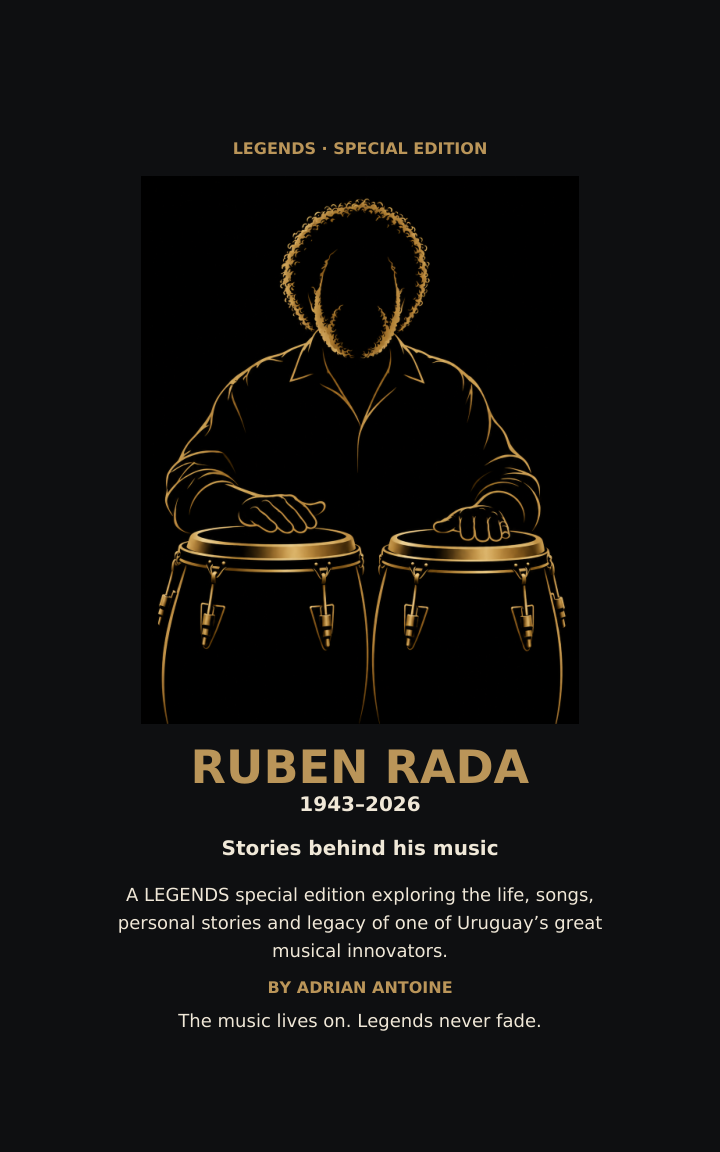
Cover of the English LEGENDS — Ruben Rada ebook

05 / Free special edition

LEGENDS — Ruben Rada

Stories Behind His Music

Explore Ruben Rada's story through his music, experiences, and lesser-known anecdotes. A special LEGENDS edition featuring his musical journey, international collaborations, and lasting influence on generations of musicians.

Download Free Ebook ↓

06 / A legacy that keeps playing

A legacy that keeps playing

Rada left a way of hearing music: listening to the neighbourhood and the world at once. His songs bring together roots, imagination, virtuosity and warmth. He died on August 26, 2026; his work lives through recordings, musicians who learned from him and everyone who sings his songs again.

Read source ↗ Agencia EFE · 26 agosto 2026

BY ADRIAN ANTOINE

Discover LEGENDS

Created by Adrian Antoine to celebrate the music, stories and legacy of great artists through musical productions, books, concerts and special experiences.

Spanish and English editions of LEGENDS by Adrian Antoine

LEGENDS — The Book · ADRIAN ANTOINE

Keep discovering the stories behind the music.

LEGENDS by Adrian Antoine. True stories about music, life and legacy: an invitation to discover the human side of unforgettable artists. See Amazon for available editions and formats.

Discover the LEGENDS book on Amazon ↗

Sources and information

Explore further

Original writing based on interviews, recording credits and historical sources. Personal memories are attributed to Rada. No lyrics or recordings are reproduced. Some interviews may require a subscription.