 SPECIAL EDITIONS
Special Editions
FLOATING
LEGENDS
By Adrian Antoine
An Immersive Live Piano Experience
Legendary melodies. Timeless stories. An unforgettable experience.
An intimate live piano concert by Adrian Antoine at Casa Harmony, with the stories behind 18 legendary songs.
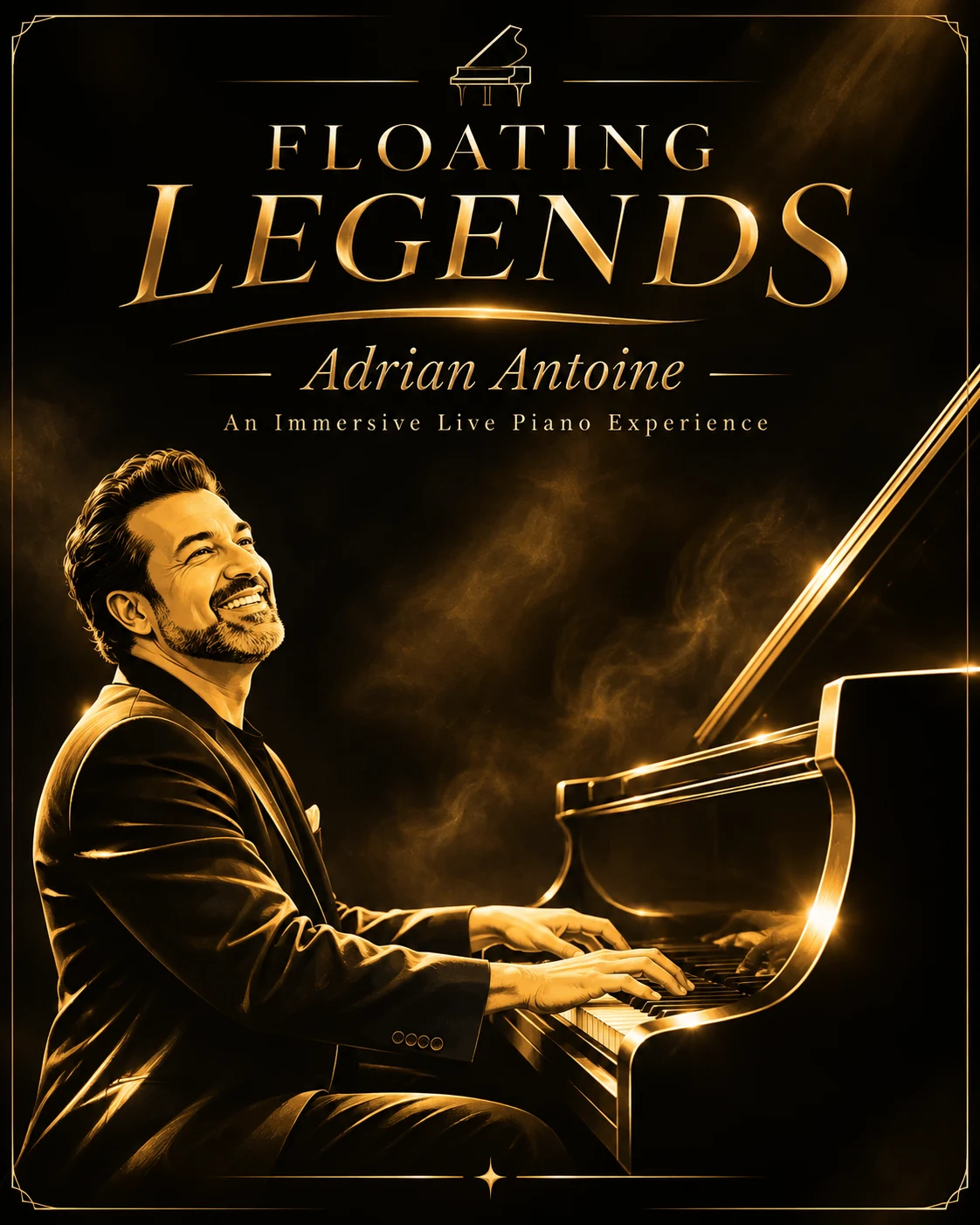
Casa Harmony · Plantation, Florida
About the experience
At Casa Harmony, Adrian Antoine reimagines songs that have traveled across generations. Listen from a floating mat or from beside the pool, with wireless headphones. Light and reflections accompany the music as the piano gives familiar melodies room to sound different.
FLOATING LEGENDS
The music — stories behind the songs
This edition accompanies the printed program. Open any song to explore its origins, its recordings and what to listen for in an instrumental arrangement.
Love of My Life
Queen
Love of My Life
Queen
On A Night at the Opera, Queen put a miniature love song next to some of the most ambitious rock production of the 1970s. Freddie Mercury wrote it and played piano, while Brian May added harp and guitar. The arrangement changes scale as it goes: a private appeal opens into stacked voices, then returns to a more exposed sound. The album also contains Bohemian Rhapsody, which makes the contrast especially striking. Both tracks use the studio as an instrument, but one needs only a few minutes and a direct melody to do its work.
In concert, May adapted the accompaniment for twelve-string guitar. Queen left enough room for the audience to carry the tune, a transformation captured on Live Killers. In that setting, a song about the fear of losing one person became something thousands of people could sing together. The crowd's phrasing is part of what distinguishes the live recording from the studio version.
At the piano, listen for the space at the end of each phrase. The upper line carries Mercury's appeal while the accompaniment can suggest the harp or the ringing guitar. An instrumental version can evoke the audience's response simply by letting those spaces stay open.
Can't Help Falling in Love
Elvis Presley
Can't Help Falling in Love
Elvis Presley
Elvis introduced this ballad in Blue Hawaii. Its melody looks back much further than the film: it draws on Plaisir d’amour, the French romance associated with Jean-Paul-Égide Martini. Peretti, Creatore and Weiss adapted that older contour into a pop song with a new lyric and structure. The result sat comfortably in a Hollywood soundtrack while carrying the shape of a much older tradition.
Presley later used it to close many concerts. Compare the gentle soundtrack vocal with the more ceremonial feeling of a concert finale. The melody does not need to change for the relationship with the audience to change completely. UB40's 1993 recording made another shift, giving the song a reggae pulse and taking it to a new pop audience.
Listen for the steady groups of three under the melody and the contrast when the bridge broadens the phrase. A pianist can keep the subdivision quiet and let the tune float over it. That separation is why the melody remains easy to recognize even when the groove changes as dramatically as it does between Presley and UB40.
Always on My Mind
Elvis Presley / Willie Nelson
Always on My Mind
Elvis Presley / Willie Nelson
This song is often identified with two famous voices, but neither Elvis nor Willie Nelson introduced it to the public. Brenda Lee recorded it before Gwen McCrae, whose single came out first in 1972. Lee's own release and Presley's followed that year. The distinction between recording and release matters: the same composition was already crossing musical worlds before it became inseparable from its most famous interpreters.
Presley's version gives the apology a sustained, expressive rise. Willie Nelson recorded it in 1982 with a conversational delivery that seems to reconsider the words as he sings them. His phrasing sits loosely against the accompaniment; the song sounds as if it is being thought through in real time. The Pet Shop Boys' 1987 version then moved that private admission onto the dance floor. The regret survives even though the rhythm and setting are almost entirely different.
In an instrumental reading, listen to the lift into the refrain and the release that follows. A pianist can suggest the difference between Elvis and Nelson by changing when a note arrives, rather than changing the note itself. It is a good example of the freedom that exists inside a widely recognized melody.
Right Here Waiting
Richard Marx
Right Here Waiting
Richard Marx
Richard Marx released Right Here Waiting on Repeat Offender in 1989. He wrote it during a separation from Cynthia Rhodes, who was working on a film in South Africa. That context is enough to explain the song's scale: the singer can promise to wait, but cannot immediately shorten the distance. The lyric uses plain language and leaves the largest emotional turn for the refrain.
The original builds around a repeating keyboard figure. The clean guitar later offers a small change of color rather than a competing melody. It is a lesson in economical arrangement: recognizable material comes back often, while the balance of instruments changes around it. The single reached number one on the Billboard Hot 100. Monica later recorded the song with 112, moving it into an R&B setting and showing how readily the tune lends itself to a different vocal approach.
At the piano, the most revealing moment is the move from verse to refrain. Try hearing the verse as the place where the speaker measures the distance, and the refrain as the answer. The notes need very little extra decoration. A slight change in the weight of the melody and the space between phrases can make the promise land.
The Lady in Red
Chris de Burgh
The Lady in Red
Chris de Burgh
Chris de Burgh released The Lady in Red on Into the Light in 1986. The story is built around a single evening: the narrator recognizes someone familiar in a new way. It is the kind of premise that can disappear under a big production, yet the record makes a point of moving gradually from quiet observation toward a refrain with much more space. The intimacy is in the timing, as well as the subject.
It became a UK number one and carried de Burgh's name well beyond the audience for his earlier work. The original remains the obvious point of comparison for instrumental and vocal readings. It belongs to the same period as Right Here Waiting, but the speakers occupy very different rooms: one has a person close enough to dance with; the other can only imagine a return.
Listen to how long de Burgh waits before giving the refrain its full weight. A piano can recreate that perspective by keeping the low register restrained through the verse and saving the fuller voicing for the point of recognition. The goal is not simply to get louder; it is to make the same space feel different once the narrator notices who is in front of him.
Human Nature
Michael Jackson
Human Nature
Michael Jackson
Human Nature began with a demo by Toto keyboardist Steve Porcaro. Quincy Jones heard it while assembling Thriller, and lyricist John Bettis helped turn the idea into the song Michael Jackson recorded. It arrived on the album in 1982 and became a single in 1983. The record gives the city a restless, almost weightless sound. Guitar, synthesizers and a soft vocal occupy different corners of the arrangement, leaving room for the small rhythmic details to come forward.
Miles Davis heard enough in the melody to make it part of his own repertoire. His recording on You're Under Arrest moves the song from pop vocal to trumpet without needing to abandon its identity. SWV later brought the texture into Right Here, putting the sound of Thriller inside a new R&B hit. Those two versions offer different ways to borrow from a record: one foregrounds the tune, the other preserves an immediately recognizable atmosphere.
Try listening for the short pattern under Jackson's lines. The vocal floats over it; the accompaniment keeps going almost as if it has a life of its own. At the piano, giving those two layers different weights can preserve the city's motion and the singer's quiet curiosity at once.
You Are Not Alone
Michael Jackson
You Are Not Alone
Michael Jackson
You Are Not Alone was released in 1995 from HIStory. It was written by Robert Kelly and became the first single to enter the Billboard Hot 100 at number one. That achievement makes it easy to remember the record as a chart milestone. Heard alongside the more confrontational material on HIStory, however, it also marks a sharp change in perspective. Jackson takes on the role of someone answering loneliness rather than asking a crowd to take his side.
The recording makes that turn audible. It begins with a relatively spare setting, and the backing voices expand the sense of company as the song builds. The repeated refrain sounds different when a single voice sings it and when more voices join. An instrumental arrangement has to find another way to make that change without losing the vulnerable quality of the opening. Harmony and register can do much of that work.
Compare it with Human Nature. The earlier song leaves its listener wandering through a city; this one aims its attention at a single person. A pianist can start with an unadorned melody, then add an answering line only after the refrain is established. That gives the accompaniment a role similar to the voices in the original: it makes a promise of company audible.
Billie Jean
Michael Jackson
Billie Jean
Michael Jackson
Billie Jean appeared on Thriller in 1982 and was issued as a single in 1983. Jackson wrote it and Quincy Jones produced the recording. The story of a disputed claim of paternity unfolds over a bass pattern that remains steady while the words become more uneasy. The opening introduces the drum rhythm and bass before the voice arrives. By then the listener already knows the track's physical character, even without knowing anything about the narrator.
Jackson's performance on Motown 25 made the moonwalk inseparable from the song's public life. The dance works partly because the bass is so reliable: feet can seem to move against the floor while the beat stays exactly where we expect it. That televised performance added a visual phrase to a record already full of compact musical ones.
There is a practical challenge in playing it without vocals. A pianist who emphasizes every accent equally can make the bass feel heavy. Keeping it quiet but clear leaves room for the upper notes to move with the tension of the story. Compare that function with the bass of Human Nature: one pins the listener to the ground; the other helps create the feeling of movement through open space.
Imagine
John Lennon
Imagine
John Lennon
John Lennon released Imagine in 1971. Its invitations to picture a different world owe a documented debt to Yoko Ono's conceptual work, especially Grapefruit. The record originally credited Lennon alone as writer; Ono's contribution received later co-writing recognition. The difference between those two credits tells its own story about the distance between making a work and publicly acknowledging who helped shape it.
The performance is unusually gentle for the scope of the proposal. A small piano figure introduces the recording, and the strings support the voice rather than turning the argument into a march. Lennon sounds as if he is thinking aloud. That conversational scale helps explain how the song has been adopted for public gatherings and memorials without losing its original intimacy. Eva Cassidy's version, for instance, restores much of the feel of a song addressed to one listener at a time.
Compare the piano opening with the opening of Piano Man. Both establish the room before the singer begins, but Lennon invites us to picture a world beyond the room, while Billy Joel introduces people sitting right there. For an instrumental performance of Imagine, keeping the recurring piano figure distinct from the melody is a way of preserving both the invitation and the pause in which a listener can answer it.
Something
The Beatles
Something
The Beatles
Something gave George Harrison a leading place on a Beatles single. It appeared on Abbey Road and shared a double A-side with Come Together in 1969. The opening leaves the object of the singer's fascination almost unnamed. The bridge admits uncertainty, and its change of key makes that uncertainty audible before the song returns to its opening world. That interplay between confidence and doubt gives the ballad more movement than its quiet beginning suggests.
Paul McCartney's bass moves independently under Harrison's vocal. The result can sound like two people finishing the same thought from different angles. Frank Sinatra, Elvis Presley and James Brown all recorded the song; the Beatles' official account notes that Harrison particularly liked Brown's interpretation. Those readings also connect Abbey Road with three very different traditions: the American popular standard, rock and roll, and soul.
A pianist can take a cue from the original bass and let the left hand answer the melody instead of doubling every change. Compare it with Yesterday, another Beatles song whose arrangements traveled well. In Something the accompaniment can be an active partner; in Yesterday there is more to gain from letting the smaller phrases speak first. Both invite a singer or instrumentalist to decide how much emotion to show and how much to leave unresolved.
Yesterday
The Beatles
Yesterday
The Beatles
Yesterday was written by Paul McCartney and credited to Lennon–McCartney. It appeared on Help! in 1965. McCartney has described waking with the tune in his head and checking whether he might have remembered someone else's melody. The working title, Scrambled Eggs, let him keep the tune while the lyric was taking shape. That detail is a reminder that the music had to sound convincing before the subject of the song was settled.
The record is unusually spare for a Beatles track: McCartney sings and plays acoustic guitar, with a string quartet arranged with George Martin. The other Beatles do not perform on it. The strings create a second layer of feeling without making the words more explicit. The track became a standard in its own right; singers including Ray Charles and Frank Sinatra could bring their own timing to it without changing the basic shape.
Listen to the difference between the suspended phrases of the verse and the more direct question posed in the bridge. A pianist can suggest the guitar in a steady figure and let a sustained note hint at the strings. There is no need to recreate every part. The original itself offers a useful lesson in what can be left out while a song remains complete.
Strangers in the Night
Frank Sinatra
Strangers in the Night
Frank Sinatra
The melody behind Strangers in the Night came from Bert Kaempfert's music for the 1966 film A Man Could Get Killed. Charles Singleton and Eddie Snyder supplied the English lyric. The song became a meeting between two people who do not yet know that their lives will intersect. Its journey from film music to a self-contained vocal hit is part of what makes the melody so useful: it can suggest a scene before anyone explains the plot.
Sinatra's 1966 single reached number one on the Billboard Hot 100. Its ending turns from words to a short, improvised-sounding vocal figure, one of the most familiar details of the recording. The figure sounds unguarded next to the carefully shaped orchestral backing. It makes a few seconds of a polished studio recording feel as if they might never happen in quite the same way again.
At the piano, listen for how a repeated shape can remain recognizable as the harmony underneath changes. The lightness of the ending is worth keeping, even without Sinatra's voice. Compare it with Fly Me to the Moon: one arrangement makes time for a close encounter, while the other uses swing to send the melody forward. Both show how much of a singer's identity can live in the way a phrase lands.
La Vie en Rose
Édith Piaf
La Vie en Rose
Édith Piaf
Édith Piaf wrote the French words and Louiguy received the music credit for La Vie en Rose. Piaf was singing it before her recording was released in 1947. A love song in the years just after the Second World War, it does something very specific: it changes the color of the world through the eyes of one person. The melody allows that private transformation to feel grand without requiring a dramatic leap at every turn.
Louis Armstrong recorded it in 1950, bringing his unmistakable voice and trumpet to a tune associated with French chanson. Decades later, Grace Jones placed it in a disco setting. Those recordings do not try to reproduce Piaf's manner. Armstrong gives the phrases a different physical weight; Jones changes the surrounding rhythm. Listening across versions makes it easier to hear which details belong to the song and which belong to the artist who is singing it.
At the piano, the long phrases are an opportunity to vary the timing of the accompaniment. The tune can lean forward or hang for a moment while the harmony quietly catches up. That freedom is also present in Sinatra's approach to a standard: the written melody provides the shape, and the performer decides how to breathe inside it.
Fly Me to the Moon
Bart Howard / Frank Sinatra
Fly Me to the Moon
Bart Howard / Frank Sinatra
Bart Howard's song first appeared in 1954 as In Other Words, recorded by Kaye Ballard. It started life as a waltz. The title most listeners now know comes from the image that opens the lyric, while the song's emotional destination is much closer to home. It is a request to say something directly after describing it in extravagant terms. That move from the cosmic to the personal is easy to hear even in a short performance.
Frank Sinatra recorded it in 1964 with Count Basie's orchestra, in an arrangement by Quincy Jones. The swing treatment in four changes the character of the melody: it now seems to step forward through the chord changes rather than turn around them. The same Quincy Jones later helped shape Thriller, a connection that crosses the apparent distance between this standard and Billie Jean. In both cases, a strong rhythmic frame makes room for a distinctive voice.
At the piano, the descending line and the moving bass are worth hearing separately. Try counting a waltz against the tune, then feeling it in four. The melody remains intact, yet the physical experience changes. It is an unusually clear example of how an arrangement can alter the way a song moves without changing what it says.
Blue Moon
Rodgers & Hart
Blue Moon
Rodgers & Hart
Blue Moon took shape during Richard Rodgers and Lorenz Hart's work for MGM. The melody went through several sets of words before the familiar lyric was published in 1934. That history is audible in the finished song only indirectly: the tune feels so settled with its familiar words that it can be hard to imagine any other. The relationship between a persistent melody and a replaceable lyric is part of the story of the American popular standard.
Compare Elvis Presley's spare Sun recording with the Marcels' 1961 doo-wop hit. Presley leaves a great deal of space between the phrases, and his high vocal sounds almost disembodied. The Marcels fill the opening with syllables and turn the song into a group event. Both preserve enough of Rodgers's shape to make recognition immediate. In one, the moon seems to hang over an empty room; in the other, the room is suddenly full.
At the keyboard, try hearing the song as a series of small returns. The regular harmonic cycle allows the melody to sound at home very quickly. The bridge provides a chance to change the light before coming back. That makes Blue Moon a useful companion to Fly Me to the Moon: the same nighttime image can lead to two entirely different rhythmic worlds.
Hotel California
Eagles
Hotel California
Eagles
The title track of Hotel California appeared on the Eagles' 1976 album and became a single in 1977. Don Felder supplied the musical foundation; Don Henley and Glenn Frey helped turn it into a story whose setting is familiar and disorienting at the same time. The song gives the listener places, voices and objects to picture, but it never hands over a single explanation for what the hotel represents. That restraint is part of why the story remains open to new listeners.
The record ends with a conversation between the guitars of Felder and Joe Walsh. The two parts can sound independent before joining in harmony. The Eagles revisited the track acoustically for Hell Freezes Over in 1994, exchanging some of the electric weight for a more exposed texture without losing the song's tension. The two versions show that the narrative does not depend on one particular guitar sound.
At the piano, a repeating chord cycle can establish the hotel as a place the listener keeps revisiting. The upper register can then bring in fragments of the vocal line or suggest the answering guitars. Compare its ending with Piano Man: both tell stories about enclosed rooms, but one gathers people together in a refrain while the other keeps the door to its story unresolved.
Hallelujah
Leonard Cohen
Hallelujah
Leonard Cohen
Leonard Cohen released Hallelujah on Various Positions in 1984. The song moves between biblical images and the difficulty of speaking honestly about desire, failure and belief. The refrain is stable enough to be a point of return, but the verses keep changing what that return means. Cohen performed different selections of verses over time, so the text listeners remember often depends on the version they first heard.
John Cale's 1991 recording brought a stripped-back piano reading to the song. Jeff Buckley drew on Cale's selection of verses for the electric-guitar version on Grace in 1994. Cale's recording later appeared in Shrek, while Rufus Wainwright sang the version on the soundtrack album. Those are separate recordings, a distinction often lost when people remember the film and the song together.
One of the most memorable musical details is the way the verse describes part of the harmonic movement while the chords are doing it. It lets a listener notice the construction without breaking the spell. On piano, a measured buildup can support that tension. The refrain need not grow larger every time; it can also become quieter, as if the performer has found a different meaning in the same word. That flexibility helps explain why the song has had so many lives.
Piano Man
Billy Joel
Piano Man
Billy Joel
Piano Man grew out of Billy Joel's work at the Executive Room in Los Angeles, where he performed under the name Bill Martin. Released in 1973, the song turns a working musician's view of the bar into a series of portraits. People come to the same room for different reasons. The pianist is both part of the scene and the person able to notice how much the others have in common. That double role is what makes the narrator more interesting than a detached observer.
The piano and harmonica establish a recognizable setting before the characters arrive. The lilting three-beat motion suits a refrain that people can sing together, even if they do not know all the verses. In concert, the participation can make the lyric's request feel literal: the crowd and the pianist create the moment the song describes. Queen's audience-led Love of My Life offers a different example of listeners taking a melody into their own hands.
At the piano, try hearing the verse as speech and the refrain as a response from the room. The steady rhythm holds the two together. An instrumental arrangement can preserve the sense of different characters by changing register or touch from phrase to phrase, then bringing those voices together for the chorus.

ADRIAN ANTOINE
Beyond the music — the LEGENDS book
In LEGENDS, Adrian Antoine collects true stories about music, life and legacy. The book and this concert share a question: what changes when you hear a familiar song again after discovering the story around it?
Artists you hear here also appear in the book: Elvis Presley, The Beatles, Frank Sinatra, Édith Piaf and Queen. Two songs in this program also have a direct connection to the manuscript: Hallelujah and Billie Jean. Explore their stories here and discover the decisions and moments behind those works in the book.
In English and Spanish · Paperback and hardcover
Casa Harmony · Plantation, Florida
Experience Floating Legends Live
Check upcoming sessions and book on Eventbrite when tickets are available.